

The Rule That Quietly Controls Federal AV Procurement
The Trade Agreements Act of 1979 isn’t something most AV teams think about—until it shuts a project down.
Because that’s what it does.
It sets a simple rule:
The U.S. Government can only buy products that are manufactured or substantially transformed in the United States or a designated country.
That’s it.
But in 2026, the enforcement, verification, and risk of getting it wrong have all increased.
If you’re specifying AV for federal work today:
No TAA compliance → no bid → no project.
What TAA Actually Means (In Practice)
“Substantially transformed” is where everything lives.
It means the manufacturing process has to create a new product—something with a different name, character, or use.
Not just assembly.
Not just final packaging.
Actual transformation.
For AV hardware, that translates pretty clearly:
- Core manufacturing happens domestically (or in an approved country)
- Components can be global—but must be transformed
- Final assembly happens domestically
- Testing and QA happen domestically
- Full documentation exists to prove it
If you can’t prove it, it doesn’t count.
And in today’s environment, “we believe it’s compliant” isn’t enough.
Why Enforcement Has Tightened

Ten years ago, this was looser.
Manufacturers self-certified. Audits were rare. Problems were often discovered late—if at all.
That’s not the world anymore.
Today, federal buyers expect:
- Clear documentation
- Traceable supply chains
- Immediate verification
The reason is simple: visibility and security.
Even something as simple as steel sourcing now matters. Not because a display stand is a security device—but because supply chain visibility is now a federal priority across the board.
So enforcement has tightened everywhere.
AV included.
Where Projects Actually Break

TAA issues rarely show up early.
They show up at the worst possible moment.
After the product is ordered. During procurement review. Or, in the worst cases, after delivery.
And when that happens, you don’t fix it.
You replace it.
That’s budget burned. Timeline blown. Trust gone.
The Heckler Approach: Remove the Question Entirely

Heckler manufactures in Phoenix, Arizona.
Not partially. Not selectively.
Everything.
Machining. Welding. Assembly. Powder coating. Testing.
All in-house.
That changes the conversation.
TAA compliance isn’t something we prove after the fact.
It’s built into how the product is made.
Which means:
- No verification delays
- No batch-by-batch compliance variation
- Full traceability, every time
You don’t have to ask, “Is this unit compliant?”
It just is.
The Broader Reality in 2026

TAA isn’t isolated. It cascades.
- GSA Schedules: Fully TAA-bound
- IDIQ contracts: Requirements flow into every task order
- DoD: Adds additional layers (NIST, JITC, etc.)
- State/local projects: Increasingly inherit federal requirements
Even if you’re not doing federal work directly…
You’re getting pulled into it.
The Most Common (and Costly) Mistakes

Assuming assembly = compliance It doesn’t. If you import a nearly finished product and bolt something on in the U.S., that’s not substantial transformation.
Confusing TAA with “Made in America” TAA includes approved countries. It’s about transformation—not marketing language.
Waiting too long to verify If you’re checking TAA after purchase, you’re already in trouble.
Ignoring supply chain shifts A vendor can be compliant today—and not tomorrow—if sourcing changes.
That last one catches people more than they expect.
Cost: The Conversation Everyone Tries to Avoid

Yes—TAA-compliant products often cost more upfront.
That’s reality.
But that’s not the full picture.
You also have:
- Verification time and admin overhead
- Risk of replacement if something fails compliance
- Schedule delays
- Audit exposure years later
And on the flip side:
- Faster, more predictable deployment
- Cleaner procurement approvals
- Less risk across the lifecycle of the project
At scale, that tradeoff usually makes sense.
How to Specify Without Getting Burned

Keep it simple:
- Ask directly: Is this TAA-compliant? Can you prove it?
- Get it in writing in your spec
- Understand where manufacturing actually happens
- Treat compliance as a requirement—not a preference
If a vendor hesitates on any of that, pay attention.
The Integrator’s Advantage

Most clients don’t fully understand TAA.
They assume everything qualifies.
It doesn’t.
That’s an opportunity.
Integrators who bring this up early—who explain it clearly—end up saving projects before they go sideways.
It’s one of those conversations that instantly builds credibility.
The Bottom Line
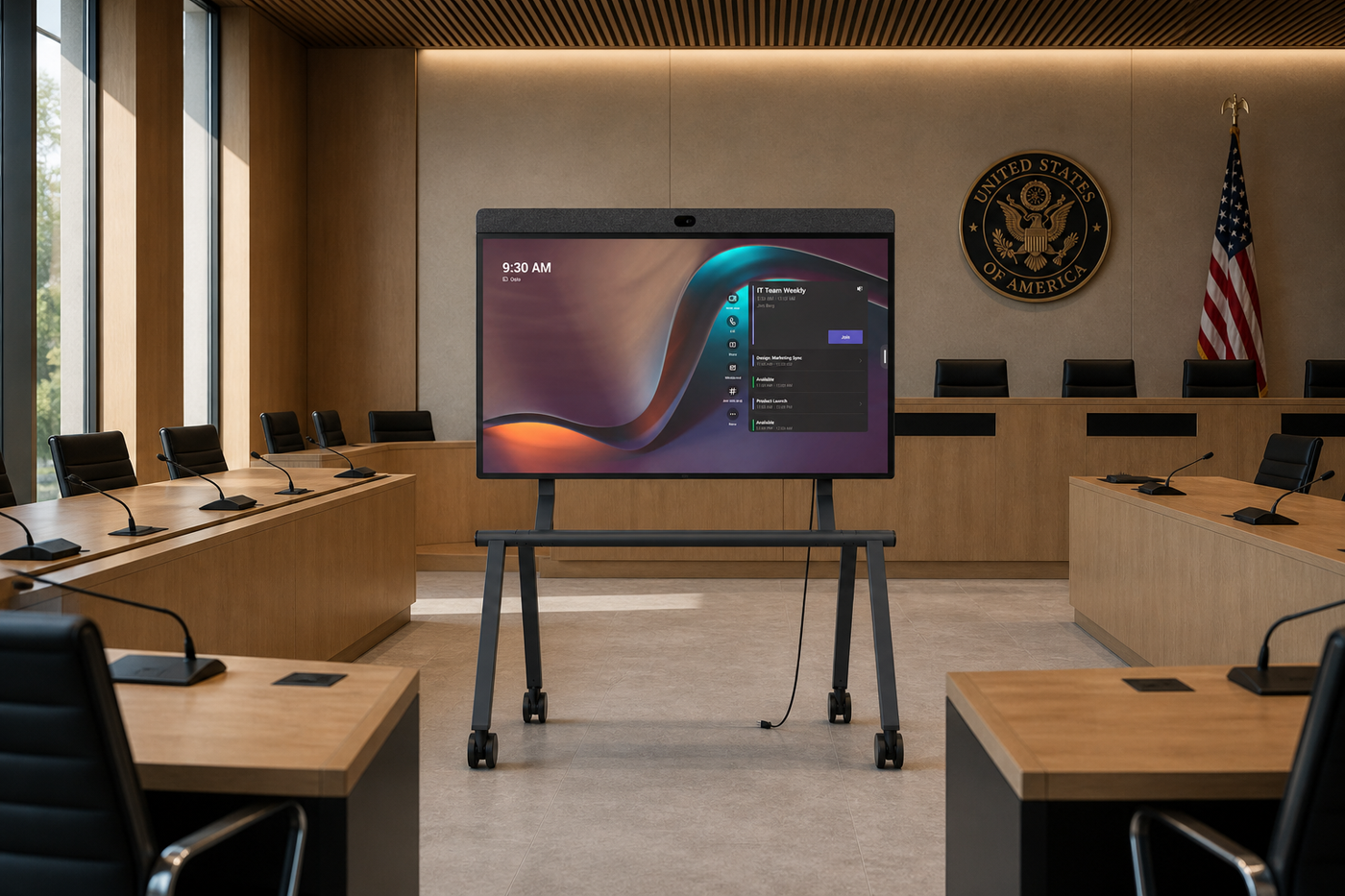
TAA compliance isn’t a checkbox.
It’s the gate.
It determines what you can specify—and what you can’t.
If you’re working in federal AV, you don’t “figure it out later.”
You decide upfront.
Heckler’s approach is simple:
Manufacture domestically. Make every unit compliant. Remove the uncertainty entirely.
Because in federal work, uncertainty is what kills projects.
Explore the full Heckler product line at heckler.com.